

Building your ICP (Ideal Cult Profile) using AI in 2025
Part Two of my Ten part series on Building your GTM from Scratch in 2025

A Special message from Eric Seto of 5min Investing who is also sponsoring today’s post.
Hey Prodcircle family,
I’m the founder of a growing FinEd AI startup, opening opportunities for high-net-worth professionals to invest in our next phase of growth. Early investors receive a 20% preferred dividend, convertible upon IPO. It’d be great to chat if this aligns with your interests.
We are developing a reliable system to consistently reach such investors and raise capital. If you would like to be an early investor (accredited investors only) and be part of this exciting journey with us while getting 20.5% dividend, here's the latest presentation and the link to schedule a call with me: https://5mininvesting.com/free-demo-for-investors/
Hello friend,
This is part two of my Ten-part series on Building a GTM from scratch in 2025.
Edition 2: Your ICP (Ideal Customer Profile) in 2025 → This Post
Edition 3: Crafting a Winning Value Proposition
Edition 4: Channel Strategy: Picking the Right GTM Channels
Edition 5: Go-to-Market Motions
Edition 6: Building Your GTM Playbook
Edition 7: Pricing and Packaging for Success
Edition 8: Metrics That Matter
Edition 9: Scaling Your GTM Strategy
Edition 10: Real-World GTM Success Stories
Alright, let’s do it.
Housekeeping:
Finding the right ICP is not a new topic. You can find tons of good advice on the internet from people far more successful/knowledgeable than me.
And that is fine by me. So, why you should read this edition? What makes it special? (bullets incoming)
I believe most of the advice out there is very generic. Based on events that happened in the past. X Unicorn did this, Y Decacorn found the growth loop like that, etc. - I think what has worked in the past is good info but maybe not the right fit for your startup.
I also believe most founders know pretty much everything. The successful ones are unbelievably resilient and lucky (you might not agree but PMF has a lot to do with luck). Dont hate me for saying these.
In 2025, we need hands-on leaders and most of the ICP advice is just ‘Find 10 people, do things that don’t scale, demo & firmographic, common attributes, etc.’ - AI can do that 10x faster than humans so let’s not waste the time.
Having an ‘Ideal Customer Profile’ is not enough. I’d encourage you to build a Cult-like audience to stand out.
1. ICP - Ideal Cult profile
Here is a real quick rundown of what the ‘Traditional Define your ICP’ includes:
Industry
Company size
Geography
Revenue
Employee Count
Key challeneges / pain
Existing tech Stack
Common attributes
You can add a few more to it but that it what it was.
This list was then followed by Personas (Who is the person/point of touch for your product).
Buyer Persona - Decision maker. Like SVP, or CXO who will make the purchasing decision
User Persona - Who will use it? Team Lead, Solutions Architect, Marketing Manager, etc.
The new way of thinking ICP aka Ideal Cult Profile
There are just too many products in almost every niche. You need a strong message, product, and GTM motion to stand out.
Narrative Transformation
The Ideal Customer Profile (ICP) is no longer about targeting anyone who might buy your product. Instead, it’s about creating a strategic foundation for building a community of passionate advocates - Loyal Repeat Customers.
Emotion Over Logic
Numbers and demographics alone can’t create a cult-like audience. True loyalty comes from emotional connections:
Why do they buy from you?
How does your product make them feel?
What story are they telling themselves when they use your product?
It’s not just about solving a problem; it’s about solving it in a way that resonates deeply with their values and aspirations.
Position it as Exclusive
Not every customer is a good customer. Cult-like audiences come from selecting the right ones—those who truly align with your brand’s ethos. That also means you need to have a very good understanding of who you are, what problem you are solving, why you are doing it, and how that will help your ideal customer. If you know these and get the positioning (upcoming edition) right, building a Cult gets easy.
Focus on finding customers who will naturally champion your product. These are the people who:
Talk about your product to friends, online communities, and colleagues.
Advocate for your brand without being asked.
They love your product and will be upset if you take it away.
They are not using it for any reward (like social acceptance, affiliate, or anything else). They just love using it
Old Metrics, New way
Signs They Love You: Look for clues like repeat purchases, social media shoutouts, or referrals. These are your “Affinity Signals.”
Your Biggest Fans: Who are the people who can’t stop talking about you? These are your “Evangelists.” Remember; these are not paid influencers
How You Make Them Feel: Track how well people connect with your story. Are they excited, loyal, and emotionally invested?
2. Using AI to Create an Ideal Cult Profile
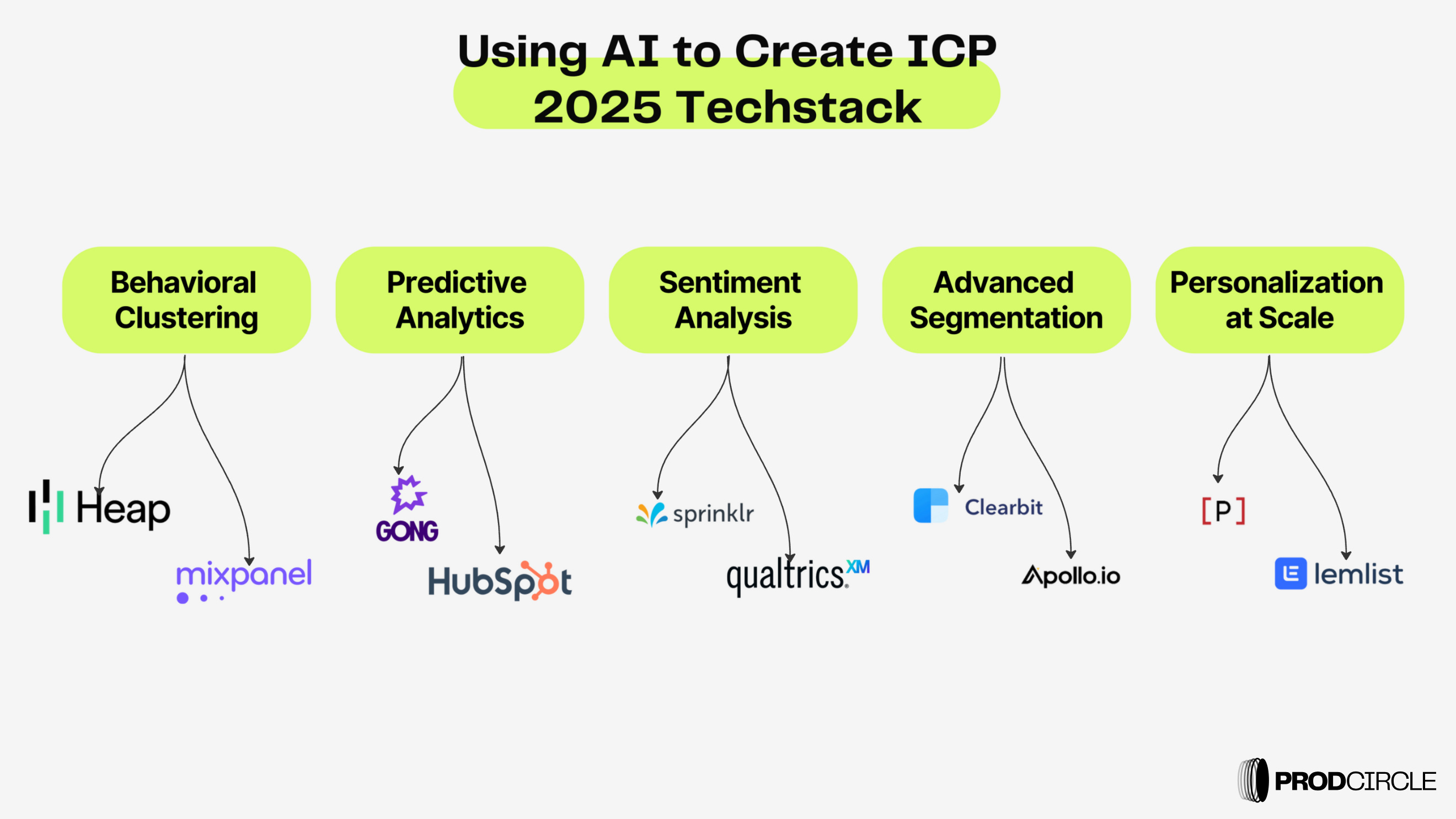
If you don’t want to be left behind you need to start leveraging AI. I can think of three categories of how AI can help us create the Ideal Cult Profile
Behavioral Clustering: AI can analyze user behaviors to identify patterns, enabling the creation of segments based on actual interactions rather than assumptions.
Here you are looking for patterns in users’ behavior. I have used Heap and Mixpanel for this. If you are early, you can use GA4.
Heap - Tracks every user interaction to automatically identify trends and patterns.
Mixpanel - Perfect for analyzing product engagement and creating behavior-based segments.
How to Use Them:
Look for recurring behaviors among your most engaged customers.
Example: Are certain features being used more by loyal customers?
Create behavior-based segments like "Power Users" or "Dormant Users" to tailor your outreach.
Use these insights to refine your messaging, ensuring it resonates with real user actions.
Predictive Analytics: Utilize AI to forecast future behaviors and preferences, allowing proactive adjustments to your strategies.
Tools to Use:
HubSpot (Predictive Lead Scoring): Automatically identifies which prospects are most likely to convert.
Gong - If your product is not 100% PLG (which I think it should be if you are early stage), you will love Gong
How to Use Them:
Prioritize leads most likely to convert by using AI scoring tools.
Example: Identify customers who’ve clicked multiple CTAs but haven’t purchased yet.
Predict what customers need next in their journey.
Example: Suggest advanced features to long-time users, or send renewal reminders proactively.
Adjust marketing campaigns dynamically, using AI insights to send timely offers or updates.
Sentiment Analysis: AI can assess customer feedback in real-time, providing insights into evolving perceptions and enabling swift responses.
Tools to use:
Clarabridge - thats the only one I use.
Talkwalker - Great if your team is producing video content especially on tiktok.
Sprinklr - Have heard great things but never used it
How to Use Them:
Monitor customer reviews and social media mentions to identify recurring emotions (positive or negative).
Example: If customers love a specific feature, double down on promoting it.
Use sentiment trends to inform product development or tweak messaging.
Example: Address negative sentiment by solving a specific complaint (e.g., improving shipping times).
Create marketing campaigns that emphasize what customers feel most excited about
Advanced Segmentation: Merge Data for Deeper Insights
Tools to Use:
Clearbit Enriches customer profiles with data points like industry, role, and funding stage.
Apollo.io Thats my favorite. And you wont be disappointed.
How to Use Them:
Layer firmographic and behavioral data to identify high-value accounts.
Example: A mid-sized SaaS company in rapid growth mode with repeat visits to your pricing page.
Prioritize leads by a readiness to buy, using tools like intent scores from 6sense.
Customize outreach based on enriched profiles.
Example: Target CMOs from funded startups with messaging focused on ROI and scalability.
Personalization at Scale: Tailor Your Messaging
Tools to Use:
Dynamic Yield: Automates personalized content delivery across websites and email campaigns.
Persado: Uses AI to craft emotion-driven, personalized messages.
Lemlist: Personalizes cold emails with dynamic images and text. (I have personally used it and love it.)
How to Use Them:
Create website experiences tailored to different user segments.
Example: Show custom landing pages for enterprise users vs. individual buyers.
Personalize email campaigns based on user actions.
Example: If a user views a demo, follow up with an email highlighting that feature.
Use AI to generate messaging that reflects customer emotions.
Example: Highlight trust and credibility for skeptical buyers or excitement and innovation for early adopters.
Section 4: Framework for Building Your Ideal Cult Profile
Some 7 or so years ago I learned two things by doing a lot of B2B sales. Its a valuable lesson but might sound cliched
Sales solve every pain. But, people buy from people.
Advantages > Benefits > Features
So the following framework is a version I created from my Sales learnings.
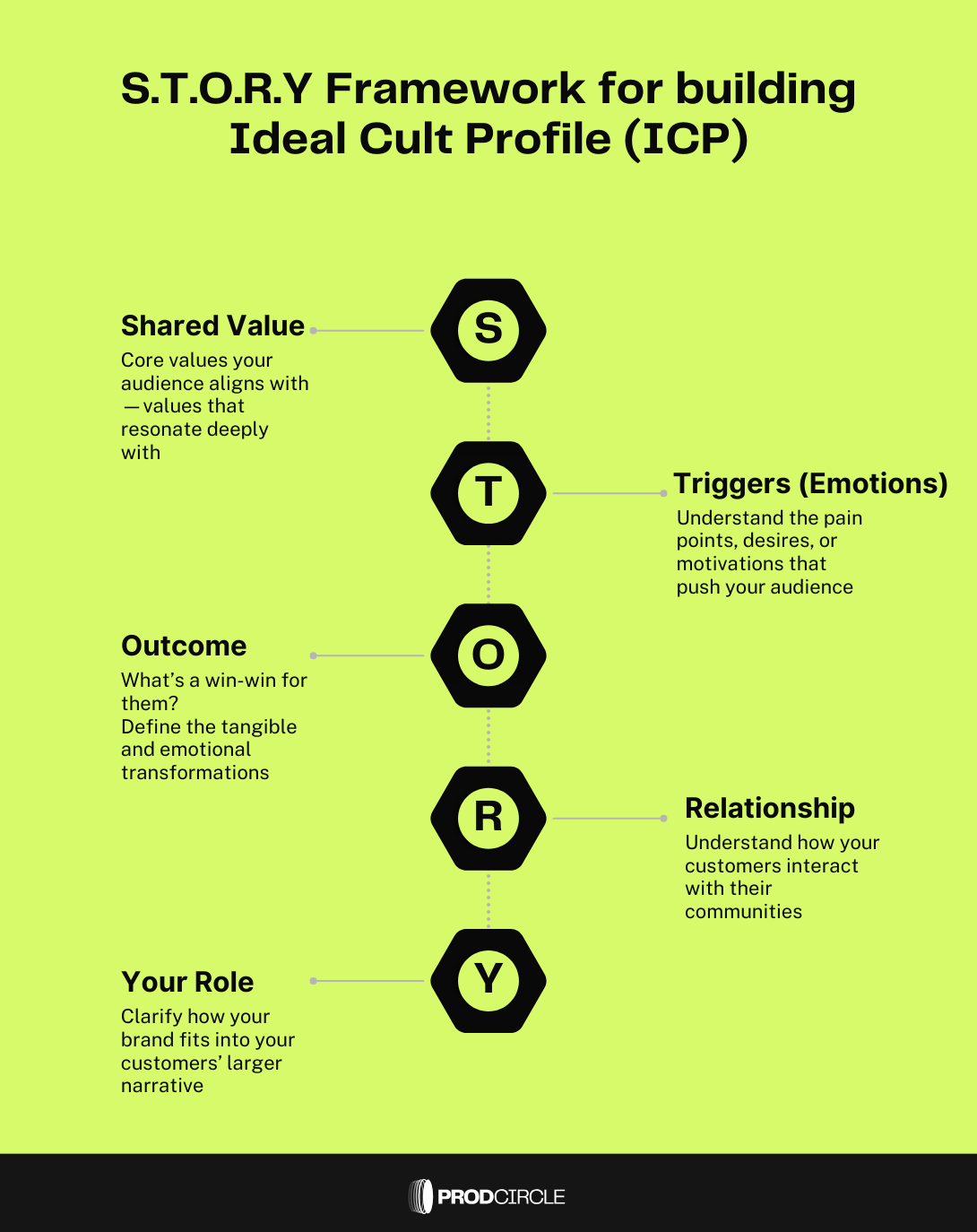
S.T.O.R.Y. Framework
Shared values: What drives your cult-like audience?
Triggers: Emotional and psychological hooks that make them act.
Outcomes: Their ideal transformation through your product.
Relationships: How they connect to others and amplify your brand.
Your role: The part your brand plays in their life story.
Let me explain them in depth. (I mean bullets)
1. Shared Values: What Drives Your Cult-Like Audience?
What It Means: Identify the core values your audience aligns with—values that resonate deeply with your brand’s mission and vision.
Why It Matters: Shared values create loyalty and a sense of belonging. Customers don’t just buy a product; they buy into a belief system. This is why you buy an iPhone and not the better Android.
How to Do It:
Survey Your Existing Customers: Use tools like Typeform (or any other) to ask questions like, “What do you value most about [your product]?”
Analyze Reviews and Testimonials: Look for recurring phrases that hint at values (e.g., “transparency,” “simplicity,” or “innovation”).
Example: A productivity app might attract users who value efficiency and balance over hustle culture.
2. Triggers: Emotional and Psychological Hooks That Make Them Act
What It Means: Start with understanding the pain points, desires, or motivations that push your audience to engage with your product. Emotions are superpower
Why It Matters: Emotional triggers drive action faster than logic. Recognizing these hooks helps you craft compelling messaging.
How to Do It:
Identify Pain Points: Use tools like Intercom or Zendesk to analyze support tickets for common frustrations.
Leverage Behavioral Data: Tools like Amplitude or Mixpanel can reveal moments of friction or delight (Aha moment) in your product journey.
Example: Customers might act because they feel overwhelmed and see your tool as a way to reclaim control.
3. Outcomes: Their Ideal Transformation Through Your Product
What It Means: What’s a win-win for them? Define the tangible and emotional transformations your audience experiences by using your product.
Why It Matters: Customers care about how your product improves their lives, not just its features. Outcomes help you position your brand as a solution.
How to Do It:
Map the Journey: Use customer journey mapping tools like Miro to outline the “before” and “after” states of your customers.
Showcase Success Stories: Highlight case studies or testimonials where customers achieved significant outcomes.
Example: A fitness app’s outcome might be helping users gain confidence, not just lose weight.
4. Relationships: How They Connect to Others and Amplify Your Brand
What It Means: Understand how your customers interact with their communities and how they can become advocates for your brand.
Why It Matters: Relationships turn customers into evangelists, amplifying your reach through word-of-mouth.
How to Do It:
Encourage Community: Use any platform you want, Discord, Slack, whatever, just get them in the same place. Build a community.
Track Referrals and Advocacy: You can use tools like ReferralCandy or Ambassador to monitor who’s bringing others into your ecosystem, or you can do it manually.
Example: A SaaS product with a strong community where users share hacks and tips increases loyalty and advocacy. Community is your moat.
5. Your Role: The Part Your Brand Plays in Their Life Story
What It Means: Clarify how your brand fits into your customers’ larger narrative—whether as a guide, enabler, or partner.
Why It Matters: Positioning your brand as essential in their story builds emotional loyalty and ensures you’re seen as more than just a product.
How to Do It:
Craft a Brand Archetype: Use frameworks like Carl Jung’s brand archetypes to define your brand’s role (e.g., Hero, Sage, Caregiver).
Communicate Through Storytelling: Share relatable stories where your brand helped customers overcome challenges.
Example: A project management tool might position itself as the coach helping teams win at collaboration.
Section 5: HeyGen’s GTM and Emotion-based ICP work
HeyGen is a generative AI video creation platform that has gained significant traction in 2024. You must have heard of it. It was everywhere. (and that is the goal when you scale, you have to be everywhere)
Here’s how I believe they fit into my framework
Shared Values:
Innovation and Accessibility: HeyGen's mission is to democratize video content creation that resonates with users who value cutting-edge technology and accessibility. These users are not afraid to try out a new technology and they love innovative ideas.
Notes - You can see that in your circle. People who have tried HeyGen are generally (emotionally) more likely to use a new product.
Triggers:
Need for Scalable Personalization: Businesses seeking to engage audiences through personalized video content are drawn to HeyGen's AI-driven solutions.
Notes - Content is big in 2024 and 2025. That means you need to do things at scale. Most of the people who have used HeyGen are people who were already creating content. They just scaled better.
Outcomes:
Enhanced Engagement: Users experience increased audience engagement and streamlined content creation processes, leading to improved marketing outcomes.
Notes - That was the perfect outcome for HeyGen’s customers. Thats what they got.
Relationships:
Community Building: HeyGen fosters a community of creators and businesses who share insights and best practices, amplifying the platform's reach.
Notes - Influencer marketing is super powerful IF done right. Most people think just sponsoring a view or a newsletter will work but that is not the case. Its evolving (I’ll write a separate post about it)
Your Role:
Enabler of Creativity: HeyGen positions itself as a facilitator of creative expression, empowering users to produce high-quality videos effortlessly.
Notes - That was the role HeyGen played. And played really well.
Bonus Section: The Common Mistakes People Make with ICPs
Treating ICP as static rather than evolving.
Over-relying on demographics and ignoring behavioral and emotional data.
Focusing on broad audiences instead of micro-niches.
Not testing the hypotheses
Not researching enough about ICPs.
Well, that was about it for Part 2.
This week on Beyond the Hype
Please let me know if you have any questions. I’d love to help you out.
M.
Enjoyed this particular post. As an ex-comms that helped scale Europe's leading insurtech into a global brand with a valuation of ¢4.5 billion, the whole "cult persona" resonates. The challenge is translating it into an emotional story - as the saying goes "emotion is the potion". In my opinion, we're moving into a new era where startups/brands will become media companies with data at the heart of the process to generate insights-led storytelling that drive GTM motions.