

Channel Strategy: Picking the Right GTM Channels
Channel Market Fit is real! And its very important.

Hello friend,
This is part four of my Ten-part series on Building a GTM from scratch in 2025.
Edition 4: Channel Strategy: Picking the Right GTM Channels → This Post
Edition 5: Go-to-Market Motions
Edition 6: Building Your GTM Playbook
Edition 7: Pricing and Packaging for Success
Edition 8: Metrics That Matter
Edition 9: Scaling Your GTM Strategy
Edition 10: Real-World GTM Success Stories
Heads up: Starting now, these posts will get lengthy and more valuable.
Alright, LFG!
Why the Right GTM Channels Matter
Early-stage startups live or die by their ability to acquire and retain customers efficiently. Choosing the right go-to-market (GTM) channels is mission-critical with limited runway and resources. Founders often discover that startup failure isn’t just about product – it’s about distribution.
Many SaaS companies fail simply because they can’t find effective ways to get new customers. A well-chosen channel can accelerate growth dramatically, giving a young startup the momentum it needs to reach its next funding round or revenue milestone.
Picking the right GTM channels is crucial for two big reasons. First, focus: you can’t do everything at once.
“You can do anything, but you cannot do everything…focus your limited resources on a carefully selected number of bets where you can make a significant and measurable impact.”
Second, Fit: different customer segments respond to different channels. The channels that worked for one company might flop for another.
You need a strategy to identify which channels align best with your ideal customer profile (ICP) and business model. In short, the right GTM channels amplify your product-market fit, while the wrong ones burn precious time and money.
Let’s get started by understanding what GTM channels are out there, and why it’s so important to pick the ones that truly fit your startup.
Understanding GTM Channels:
“GTM channels” are the paths through which you acquire customers and generate demand. At a high level, channels can be grouped into a few categories – inbound vs. outbound, product-led vs. sales-led, community-led, content-driven, paid, partnership-led, etc.
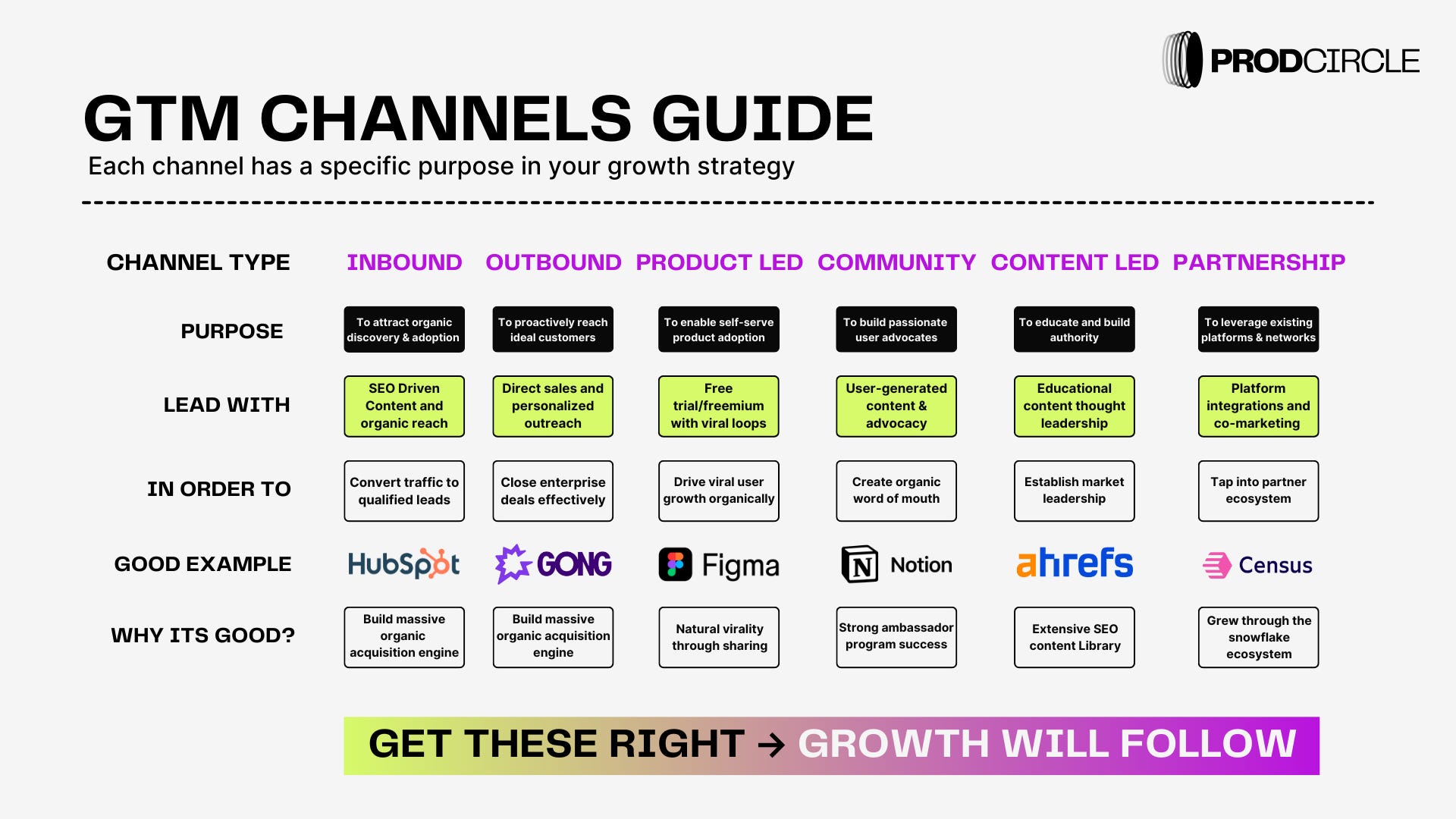
1. Inbound Channels (Organic Growth)
Customers find you through search, word-of-mouth, or social proof.
Self-serve inbound: Users discover and adopt the product on their own (e.g., Loom, Figma, Notion).
Sales-assisted inbound: Interest is generated via content, referrals, or SEO, then converted by a sales team (e.g., Looker, Ramp, Vanta).
Works best when your audience is already searching for a solution.
2. Outbound Channels (Proactive Outreach)
You actively reach out to customers via cold emails, LinkedIn, or calls.
Common for B2B sales, especially for high-ticket or complex products (e.g., Gong, Zip, Zoom in its early days).
Works well when your ICP is well-defined, but CAC can be high.
3. Product-Led Growth (PLG)
The product itself drives adoption via free trials, freemium models, or viral loops.
Examples: Slack, Zoom, Dropbox (referral programs), Figma (collaborative files).
Best for products that are easy to try and provide immediate value.
Caution: Complex, high-priced, or enterprise-focused products may need sales support.
4. Community-Led Growth
Users advocate for the product, creating organic adoption.
Examples: Notion (ambassador programs), Slack (team adoption), GitHub (developer communities).
Works well when a passionate user base naturally forms around your product.
5. Content & SEO
Creating valuable content to educate and attract leads.
Examples: HubSpot (blog-driven growth), Zapier (SEO-optimized help articles), Vanta (security compliance thought leadership).
Best for industries where buyers actively search for solutions.
Long-term investment but highly scalable once successful.
6. Paid Acquisition (Ads & Sponsorships)
Directly buying traffic via Google Ads, LinkedIn, Facebook, or influencer sponsorships.
Quick feedback loops but requires rigorous CAC-to-LTV tracking.
Works well for startups with clear targeting and strong conversion funnels.
7. Partnerships & Integrations
Leveraging existing platforms, marketplaces, or referral networks.
Examples: Census grew through Snowflake’s ecosystem, SaaS startups integrating with Salesforce or Shopify.
Best for B2B products that benefit from co-marketing or integration synergies.
Most breakout startups win with just one or two primary channels in the early days. Your job is to test and validate what works best for your audience, starting lean and doubling down on proven traction.
In the next section, we’ll dive into a framework for identifying and prioritizing these channels effectively.
How do you figure out which channels will work for your startup? It’s a daunting question because there are so many possibilities.
Gabriel Weinberg’s Traction book famously lists 19 different traction channels ranging from viral marketing to trade shows. The reality is you can’t pursue all of them at once. You need a framework to evaluate and prioritize channels based on your business. Here’s a structured approach to selecting the right GTM channels:
Go-to-Market Strategy Framework
1. Understanding Your Customer Base
Identify the specific type of customer who gets the most value from your product and has the problem you're solving. This means mapping out who makes purchasing decisions, who uses the product, and what business value they're seeking. This foundation determines every channel choice you'll make later.
2. Market Awareness Assessment
This step means figuring out if your target customers already know they have the problem you solve. High awareness means they're actively searching for solutions. Low awareness means you'll need to first educate them about the problem before you can sell the solution. This distinction fundamentally changes your entire marketing approach.
3. Channel Selection Process
Look at every possible way you could reach customers - from content marketing to direct sales to partnerships. Don't skip channels just because they're unfamiliar. Instead, evaluate each based on how much it costs to acquire customers, how many customers you can reach, how quickly you'll see results, and how much control you have over the process.
4. Validation Strategy
Pick the most promising 1-3 channels and run small, controlled tests. The goal isn't perfection - it's learning quickly whether a channel can deliver customers at a cost that makes sense for your business. Set clear metrics before testing so you know what success looks like.
5. Growth Engine Development
Once you find a channel that works, focus intensely on optimizing it. This means committing resources and becoming excellent at executing that specific channel. Only when you start seeing diminishing returns should you consider adding another channel to your mix.
Step-by-Step Execution Plan for Founders
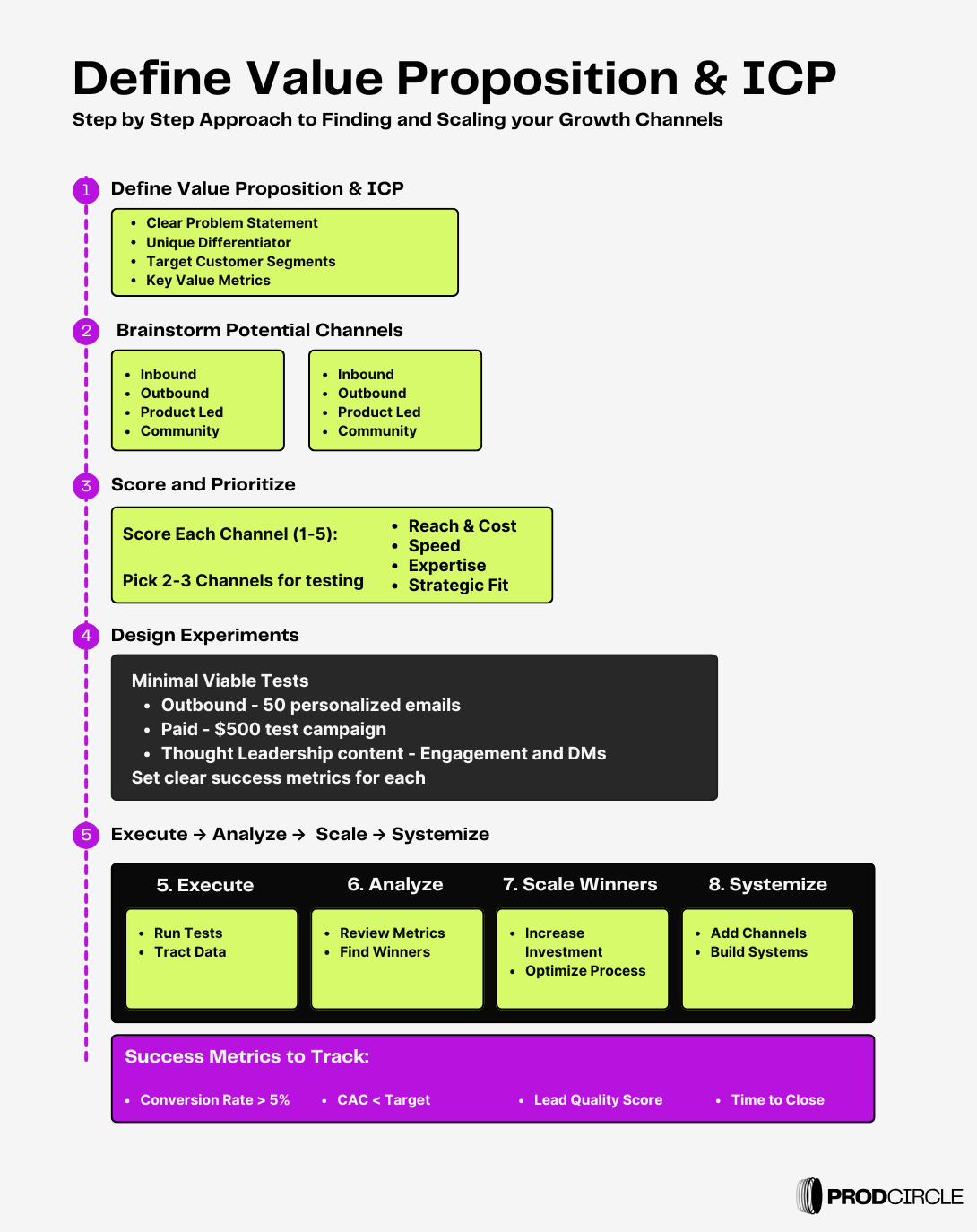
1. Define Value Proposition & ICP
Clearly articulate the problem you solve, your unique differentiator, and your ideal early adopters.
If targeting multiple segments, tailor GTM efforts for each (e.g., developers vs. HR managers).
2. Brainstorm Potential Channels
List all possible GTM channels: inbound (SEO, referrals, content), outbound (cold emails, LinkedIn), community, product-led loops, social media, PR, events, partnerships, paid ads.
Research how similar startups acquired users.
Consider unconventional ideas (e.g., guerilla marketing, influencer sponsorships).
3. Prioritize Channels Using a Scoring System
Score each channel on:
ICP reach (Does it target your audience effectively?)
Cost (Affordable vs. expensive?)
Speed to test (Quick vs. long-term results?)
Expertise (Does your team have the skillset?)
Strategic fit (Does it align with your strengths?)
Identify 2-3 high-potential channels.
4. Design Small Experiments for Top Channels
Define a minimal viable test for each channel:
SEO/content: Publish 2-3 blog posts, track traffic and conversions.
Outbound sales: Send 20 personalized cold emails, track replies and meetings booked.
Community: Engage in relevant groups, measure profile/product visits.
Paid ads: Run a $200 campaign, analyze CTRs and sign-ups.
Set clear success criteria (e.g., 5 demo requests, 10% email response rate).
5. Execute and Track Data
Run experiments with discipline, isolating variables.
Use tracking links, landing pages, and ask new users how they found you.
Document qualitative insights (e.g., user feedback, unexpected patterns).
6. Analyze Results Objectively
Identify the most promising channel based on:
Highest conversion rate and sign-ups.
Best customer acquisition cost (CAC).
Quality and engagement of leads.
If all results are weak, tweak or test a new channel.
7. Double Down on the Best Channel
Allocate more time, budget, and effort into scaling the winning channel.
Optimize messaging, refine targeting, and improve efficiency.
Experiment within the channel (A/B test ads, refine outreach, expand content strategy).
8. Systematize & Layer Additional Channels
Once the primary channel delivers repeatable success, explore a second channel.
Avoid premature expansion—focus on maximizing ROI before diversifying.
Gradually build a multi-channel GTM strategy as you scale (e.g., 60% inbound, 30% outbound, 10% partnerships).
Start with 1-2 focused channels, validate them through structured testing, and scale the most effective ones. As your startup grows, strategically layer additional channels to sustain long-term GTM success.
Common Pitfalls & Mistakes in Choosing GTM Channels
Even with a solid plan, it’s easy to stumble in executing a channel strategy. I’ve made a lot of these mistakes and I see more founders making these.
Selecting GTM channels is one of the most important strategic decisions for an early-stage startup. It can feel overwhelming, but remember these key insights as you craft your channel strategy:
1. Spreading Too Thin, Too Soon
Trying to execute multiple channels at once dilutes impact.
Focus on mastering one or two channels before expanding.
“You can do anything, but not everything.” – Maja Voje.
2. Ignoring Product-Market Fit Signals
Scaling GTM before confirming product-market fit leads to wasted spend.
Validate product demand first (e.g., through organic reach, referrals, and retention metrics).
3. Choosing Channels That Don’t Align With Your Audience
Don’t choose channels based on founder preferences—align with customer behavior.
Validate by asking, “Where do customers typically discover solutions like ours?”
4. Underestimating Cost and Effort
Every channel requires time and iteration (e.g., SEO takes months, outbound requires persistence).
Set realistic timelines for success and budget for experiments to avoid premature abandonment.
5. Not Measuring or Attributing Correctly
Without tracking, it’s impossible to optimize.
Use UTM links, analytics, and direct customer feedback to pinpoint the most effective channels.
6. Sticking With a Failing Channel
Avoid the sunk-cost fallacy—if data shows a channel is underperforming, pivot.
Example: “If CAC on Channel X is still 5x higher than Y after 3 months, reallocate budget.”
7. Over-Relying on One Channel
Early success can lead to complacency—mitigate risk by layering new channels before traction plateaus.
Example: B2B startups often add sales teams as they scale beyond PLG.
8. Forcing a GTM Model That Doesn’t Fit
Don’t insist on PLG if your product needs a hands-on sales approach (e.g., enterprise SaaS).
Stay flexible—adapt based on user feedback and real-world adoption patterns.
As a founder, you are essentially the architect of your startup’s growth machine. In the very beginning, you’re also the engine, often doing things manually. Over time, you replace manual effort with scalable channels and repeatable processes. Choosing the right GTM channels is about deciding where to build the machine’s components first. With the research, frameworks, and examples we’ve covered, you have a blueprint to approach this decision with confidence and clarity.
Sounds like you're wrestling with too many channels at once and not enough signal. You could try narrowing experiments and running targeted outbound tests with MailsAI to validate fit quickly. That approach usually cuts wasted spend and surfaces the channels that actually bring steady demos.